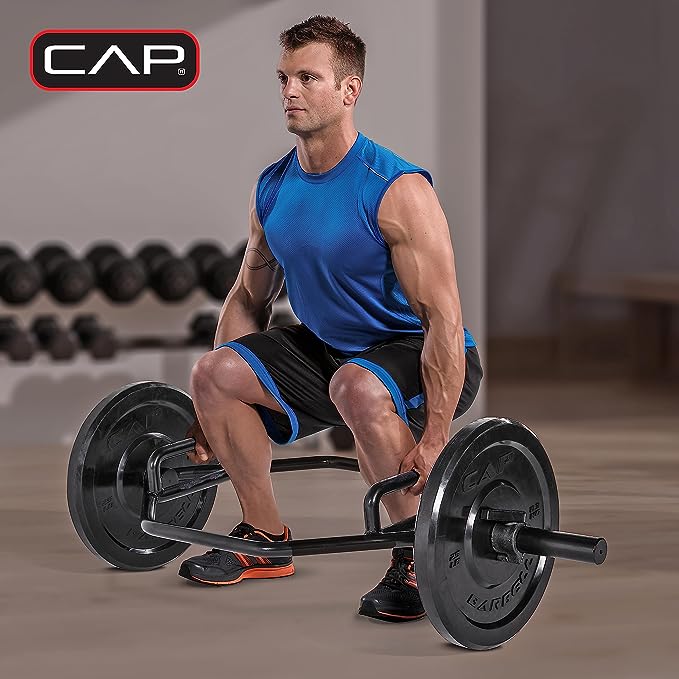
The Hex Bar Deadlift is one of the few lifts that can completely transform your athleticism. This lift, used by athletes from high school to professional level, has the ability to hit nearly every muscle on your skeleton. With the right programming, you can use this lift when strapped for time to get a heavy, taxing workout in very short order.
Back in 2019, Ryan “Dont-Call-Me-a-Celebrity-Trainer” Flaherty was chronicled by Men’s Health Magazine about how he developed the idea of a Force Calculation to develop athletes for the combine. This calculation, which to it’s core is simple; 1 rep max hex bar deadlift divided by one’s weight, has been used to a 99th percentile accuracy as to how well an athlete will perform at their said sport. Flaherty adds that with this one lift, you can stress roughly 90% of your skeletal muscle, and adding in some additional bodyweight unilateral movements is enough to target the entire body.
This, then, is one of the most beneficial exercises to keep in your repertoire when accounting for value per minute of your workout. The Hex Bar deadlift, in its high-bar form, can make you enormously explosive. Flaherty notes that you should be shooting for a force number of around 2.5 for the average well-trained athlete. 3.0 and higher for the professional athlete. This is something we can strive for, and with the right programming can be achieved naturally.
It is important to note that Flaherty is paid $20,000 per highly exclusive slot from clients who have a lot to lose. These are NFL prospects who trust the coach with their athleticism to help them become more appealing draft picks. They are entrusting him with their career. A failure at the combine could knock literal millions of dollars from their short careers.
Buying the right Hex Bar for your home gym
There are several different styles of Hex Bar you can choose when buying for your home gym. Depending on the amount you are willing to spend, you can have a fairly standard bar, and if you decide to spring for something fancier, you can have a bar with an open gap in the front which allows for lunges. Lets dive in.


- Cap Barbell Olympic Hex Bar – This is your basic Hex Bar, which would be a great addition to any space strapped person. It can handle 750lbs, which is plenty for the average gym goer. As of this article the reviews stand at 4.7/5.


- Bells of Steel Open Trap Bar Hex Bar 3.0 – A highly recommended Hex Bar, the front is carved out to allow for lunges. This is a great addition to your home gym because of the added versatility without losing any of the utility. Extra points for the blunt ends that allow for the bar to be easily stored against a wall or in a closet. 700lb capacity.


- Olympic Hex Bar Solid Steel Sleeve 1000lbs Weight Capacity Trap Bar Deadlift Bar – This bar is for the lifter who has already advanced into the higher strength arena. This one will hold up to 1000lbs, and weighs 52lbs.
One thing to note about loading a hex bar rather than an ordinary 7′ olympic bar- if you are used to bumper plates, you will not be able to fit as much weight on the bar as you would conventional thin steel plates. Now, because this movement can typically be loaded with heavier weights, it is recommended to have thinner non-bumper plates so you are able to load with the appropriate amount of weight. I recommend the cheapest weights you can find on Amazon:


- Cast Iron Olympic Weight Plates – You do not need a fancy weight. Weight is weight. For our purposes here we are looking for the thinnest weights we can find so that you can really load up this exercise.
The Hex Bar Deadlift can be a very taxing lift when done to failure, or with high volume. It is important to remember this when programming into your workout routine. There are a few different ways we can approach programming the Hex Bar deadlift into your routine. If you are looking to supplement to a hypertrophy program, you will want to look to keep the sets between 3-5 and the reps from 6-10.
The way I personally program the Hex Bar into my routine is to fall back onto what I know as the best balance between strength and hypertrophy; that being 5×5 at 80% of my one rep max. This strikes a balance between not going overboard with the reps to put you into a heavily taxed central nervous system, which may be harder to recover from, and also gives me enough volume to pack on additional muscle. This is an approach that is recommended by Bill Kazmaier, and one that I also follow as well.
For accessory lifts around the Hex Bar, Flaherty recommends unilateral leg work, such as rear leg elevated single leg squats, single leg jumps onto a bench or box, and your standard compound upper body movements (overhead press, bench, chins, dips, etc). Obviously these do not need to be performed all on the same day; this routine should be done 2-3x a week to avoid under recovery.
Another plus to the hex bar is that it can be flipped over to the “lower handle” and used as a substitute for squatting. It is to be said that you will not be able to go much below parallel, however, I have found that you will still get a heavy stress on your quads. If you are looking to get as deep a range of motion as a conventional squat, look to raise your footing area to the same height as the handles. This ensures you get a full range of motion.
A lot of us look to find one silver bullet that can satisfy our entire workout, and I can say confidently that the hex bar deadlift can nail about 90% of all skeletal muscle. The only additional lifts needing hit are some overhead presses and some chest work. With the hex bar you are hitting your posterior chain, quads, abs, calves and traps.
One pitfall to avoid, that I know I also fall into, is not trying a version of an exercise because I’m not sure it will work my body the way I want it to. It is important to try these routines for yourself, every body is different, and you might find these work even better than you expected.
Happy Lifting!
 MASS x ACCELERATION
Leave a comment